Bee Packages 1.5 kg ORDER FORM – March 13

$51.75

**This ORDER FORM is for 1.5 kg Bee Packages ONLY

>>the smaller and more popular  1 kg packages are available on 3 dates at this LINK 

Your contact info will be collected during CHECK OUT.

We do not have a firm cost yet but generally between  $350 or higher.

Your Deposit will CONFIRM your order.  We need this so that we have firm numbers.  The balance of payment is due 10 days prior to delivery.

The NON REFUNDABLE Deposit amount is $51.75 each  ($50.00 each if you pay by e-transfer, cash or Debit)
E-transfer to pat@cowichan-bees.com

We get our Bee Packages from New Zealand and Tazmania).  The packages include:

What is A Package of Bees

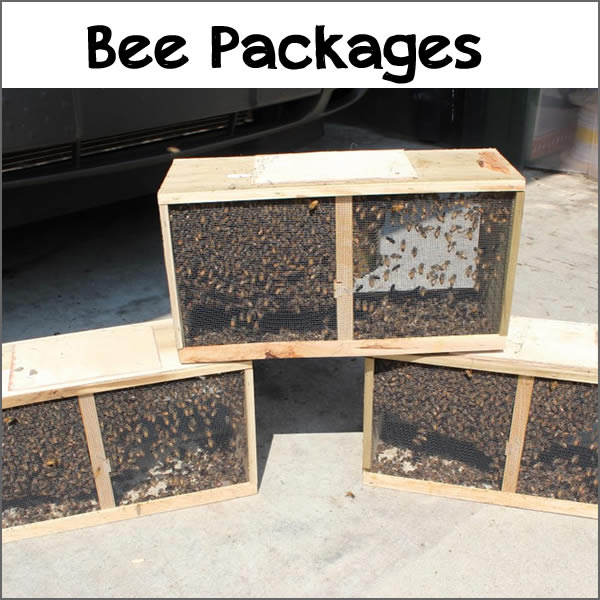
  • it  is approx. 15,000 bees in a screened box   (1.5kg) from Tasmania
  • a Queen that is in a cage but not inside with the bees.
  • A phermone strip inside with the bees.
  • A food container to sustain them during transport.

We have One date only for 1.5kg packages.

  • March 13 from Tazmania (Australia)   1.5kg

**the 1 kg bee packages are available on 3 dates.  LINK to 1 KG packages

NOTE:  Bee packages are NOT recommended for people just starting as a new beekeeper.  We recommend NUCS (Nucleus Colonies for brand new beekeepers)

*Your name and contact info will be collected on the CHECK OUT Page.

DELIVERY:  3 options 1.  Pick up at Pat’s farm  2.  View Royal  3.  Nanaimo Woodgrove

***This order form is for 1.5 kg packages only

You are ordering 1.5kg packages on this form.  Choose the quantity below.

I understand

that the deposit amount is $51.75 per package ordered . If I pay by Cash, E-transfer or Debit the amount is $50 per package ordered.

.
.
Deposit option

I am paying be Cash, E-transfer or Debit. pat@cowichan-bees.com is the email address for e-transfers *DO NOT SEND by Text. This is auto-deposit

Scheduled Date of PICK UP

*sometimes airlines are delayed so March 13 is not an absolutely firm date. We can hold them till Saturday March 14, but the delivery to Victoria and Nanaimo will be on the 13th hopefully 10am View Royal and Noon Nanaimo.

How to Install a Bee Package that comes in a box

*different instructions for New Zealand Bees and Tasmanian Bees.
*Please read this carefully.

About Tasmanian (Australian) Bees

These bees are sourced from the Australian states of Tasmania and Western Australia. These regions are some of the last in the world that are Varroa mite free. They come from approved, premium bee keepers in these regions with an emphasis on bee health and vitality. The beekeepers are inspected by AQIS to conform with all CFIA import requirements.

Bees are selected from hives towards the end of the natural honey flow. This is from the end of February to the beginning of May. They are packed into 1kg or 1.5kg units ready for air transportation. The packaging includes a feed bottle for the journey. They are shipped in wooden containers with breathable mesh to house the bees, allowing the bees to be hydrated when they are on route. Real time monitoring keeps the supplier up to date on transport conditions resulting in happy healthy bees on arrival in Canada. Vancouver is the port of entry with daily arrivals from Sydney. After clearing customs pick up is available for our customers in BC.

The Tasmanian Bee packages come with a phermone strip inside with the bees and the Queen is in a separate cage. Please watch these videos and READ THE NOTES BELOW:
Videso on how to install Tasmanian Bee Pakages (not the same as the New Zealand bees)

TASMANIAN BEE PACKAGES info:

Each package comes with one caged queen; HOWEVER, this queen will come separately and outside of the package. Inside the package there will be a pheromone strip to simulate being queenright. The queen is then introduced to the package at the time of installation after removing the pheromone strip. The queen must be allowed to slow release so the colony will have time to get used to her new phermone.

**IMPORTANT*** TAKE THE PHERMONE STRIP AND PUT IT FAR AWAY SO THE BEES DON’T FLY TO IT.  An indoor garbage can would work.

These queens will be Italians(golden)  or possibly Carniolans (Black). You might consider re-queening later in the season with queens that may be suitable for our climate and conditions.

These bees come in a box-style package. The top has a plug that can be removed and the bees shaken through the hole, or (our recommendation) the front screen can be cut and the bees shaken out that way..

Tasmanian packages are varroa-mite free, which can help delay mite build-up until later in the year. However, please note that Tasmanian packages often contain the more minor pest called ‘Braula Fly’ or ‘Bee Louse’. The Braula Fly steals food from bee’s mouthparts, and they are often attracted to the queen in particular. As such, it is not uncommon to find them during and after package installation and can easily be mistaken for a varroa mite if you do not expect to see them.

You can find more information on them here: https://beeaware.org.au/archive-pest/braula-fly/.


About New Zealand Bees

You Tube Videos:

>> YouTube Video on How to install a New Zealand Bee package from Kintail

https://www.youtube.com/watch?v=70ODILM3qcM

https://www.youtube.com/watch?v=DVz26rW7hjY

Packaged bees arrive from our friends at Kintail Honey in New Zealand

Should I feed my packaged bees once they are installed?

Sugar Syrup. Prepare a sugar syrup solution of 1:1 sugar-water before the package is installed.

Feeding fumagillin medicated syrup to newly installed packages is highly recommended

Unless you install your packages on drawn combs containing sufficient honey and pollen (taken from existing colonies or from storage), you should plan to feed the bees immediately upon installation and continue feeding them until they are able to fend for themselves. This is critically important when installing packages on foundation.

 Getting Ready for Package Arrival

Apiary Site Selection. A sunny, wind-protected and well drained location should be selected. Sunlight will warm the colony and stimulate foraging.

Install an entrance reducer for the colony to conserve heat and prevent robbing.

When many colonies are being established from packages, hives must be temporarily closed completely by stuffing grass in the entrance to prevent robbing. The grass can be replaced with an entrance reducer after the bees have settled.

Beehive equipment including bottom board, hive body, inner cover and hive lid should be ready before packages arrive.

Preparation of the brood chamber. Nine or ten frames are used in the brood chamber. When using ten, start with nine frames when the package is installed, and add the tenth frame one week later. Use frames with honey and pollen stores when available. If the frames are numbered 1 to 9, then frames 1, 2, 8, and 9 should contain honey, while 3 and 7 should have pollen. The central frames 4, 5, and 6 should be about 75% free of honey and pollen to provide room for brood development. Some dead brood from the previous year in the centre frames is of no concern because the bees will quickly clean them out.

How to Make Sugar Syrup for Package Bees

A one-to-one mixture of sugar and water — measured either by weight or by volume — provides the energy your bees need to stimulate brood rearing and start drawing out foundation.

To make the sugar syrup, heat the mixture gently until all of the sugar is dissolved. Remove the syrup from the heat and let it cool to room temperature. Once it has cooled, we suggest adding fumagilin-B to control Nosema and Honey-B-Healthy  or HIVE Alive to make the sugar syrup more attractive to the bees and to improve their gut health.

Suggestions for Sugar Syrup

  • Ratio 1:1 white sugar dissolved in water
  • Treat for mites with APIVAR or Oxalic Acid
  • Fumagilin-B to prevent nosema as directed on package
  • Honey-B-Healthy  or Hive Alive as a health supplement. Essential oils for good gut health.

Should I feed my packaged bees once they are installed?

Sugar Syrup. Prepare a sugar syrup solution of 1:1 sugar-water before the package is installed.

Feeding fumagillin medicated syrup to newly installed packages is highly recommended

Unless you install your packages on drawn combs containing sufficient honey and pollen (taken from existing colonies or from storage), you should plan to feed the bees immediately upon installation and continue feeding them until they are able to fend for themselves. This is critically important when installing packages on foundation.

 Getting Ready for Package Arrival

Apiary Site Selection. A sunny, wind-protected and well drained location should be selected. Sunlight will warm the colony and stimulate foraging.

Install an entrance reducer for the colony to conserve heat and prevent robbing.

When many colonies are being established from packages, hives must be temporarily closed completely by stuffing grass in the entrance to prevent robbing. The grass can be replaced with an entrance reducer after the bees have settled.

Beehive equipment including bottom board, hive body, inner cover and hive lid should be ready before packages arrive.

Preparation of the brood chamber. Nine or ten frames are used in the brood chamber. When using ten, start with nine frames when the package is installed, and add the tenth frame one week later. Use frames with honey and pollen stores when available. If the frames are numbered 1 to 9, then frames 1, 2, 8, and 9 should contain honey, while 3 and 7 should have pollen. The central frames 4, 5, and 6 should be about 75% free of honey and pollen to provide room for brood development. Some dead brood from the previous year in the centre frames is of no concern because the bees will quickly clean them out.

How to Make Sugar Syrup for Package Bees

A one-to-one mixture of sugar and water — measured either by weight or by volume — provides the energy your bees need to stimulate brood rearing and start drawing out foundation.

To make the sugar syrup, heat the mixture gently until all of the sugar is dissolved. Remove the syrup from the heat and let it cool to room temperature. Once it has cooled, we suggest adding fumagilin-B to control Nosema and Honey-B-Healthy  or HIVE Alive to make the sugar syrup more attractive to the bees and to improve their gut health.

Suggestions for Sugar Syrup

  • Ratio 1:1 white sugar dissolved in water
  • Fumagilin-B to prevent nosema as directed on package
  • Honey-B-Healthy  or Hive Alive as a health supplement. Essential oils for good gut health.